Agentic AI
AI systems that work in daily operations — not just in the slide deck.
Most AI projects fail not because of the technology — but because AI systems are treated as experiments rather than engineering projects. agenticonsult builds systems that hold up in production.
Why AI projects fail
Over 40% of all AI projects are discontinued — due to rising costs, unclear value, or missing plans for operation. Only 11% of companies have AI systems genuinely running in production. This is not a technology problem. It is an architecture and planning problem.
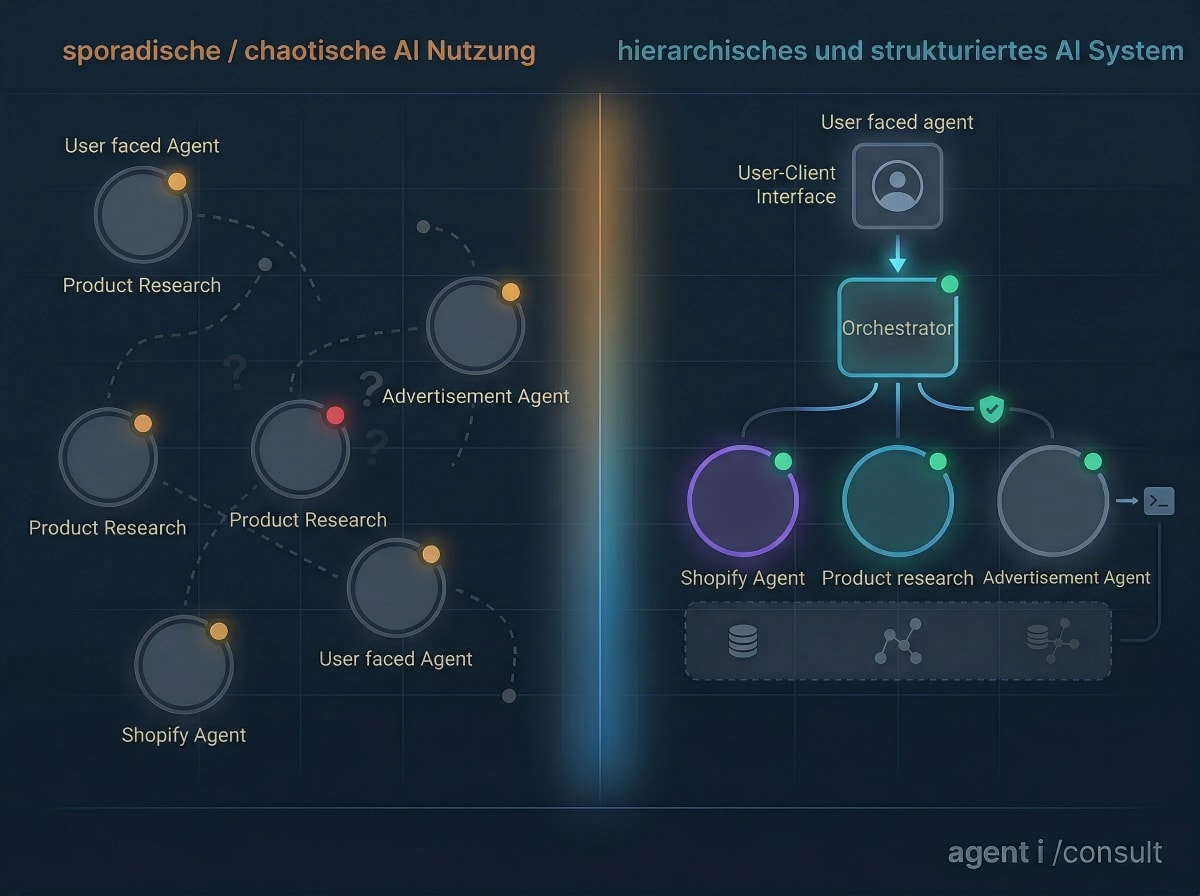
Unnecessary complexity
Most AI systems do not fail because of missing intelligence — they fail because of unnecessary complexity. The result is instability — expensive to run, difficult to maintain. Simplicity is not a compromise; it is a prerequisite for stability.
Missing foundations
AI systems only work as well as the data and context they receive. Without solid data foundations and thoughtful context engineering, even the best models remain unreliable.
No plan for operations
Prototypes in the sandbox always work. In production, security, compliance, error handling, and ongoing maintenance come into play. Building AI systems without an operations plan is building on quicksand.
Key insight: Current research (2026) shows that over 90% of all failures in AI systems are classic software engineering problems — compatibility issues, missing validation, error handling. Building AI systems with engineering discipline resolves the majority of problems before they arise.
What matters in production
Three dimensions determine whether an AI system operates reliably — or breaks at the next edge case.
Clear task distribution
AI systems work when each agent has a clear role. The right architecture determines whether a system scales or runs in circles. The governing principle: the simplest solution that solves the task — complexity only where it provably adds value.
Context & knowledge
AI systems fail for want of context, not want of intelligence. Structured knowledge management, persistent memory, and targeted retrieval are the foundation for reliable results — regardless of the model used.
Quality assurance & control
Without systematic testing and monitoring, every AI system is a black box. Test scenarios, automated checks, and human control points separate demo from production. This also includes EU AI Act-compliant documentation and traceability.
How agenticonsult structures AI systems
In practice, architecture determines success or failure — not the model. The approach relies on proven patterns operated in production: from simple pipeline flows to specialised orchestrator-worker hierarchies.
The governing principle: the simplest system that solves the task. Multi-agent systems can drive costs exponentially — each additional agent multiplies token consumption, complexity, and error sources. Optimised context engineering and targeted specialisation keep systems lean, stable, and affordable. Complexity only where it provably adds value.
An orchestrator-worker system with specialised agents outperforms a single generalist by over 90% on the same task — via parallel specialisation and clear separation of concerns.
Sequential / Pipeline
Agents in a defined sequence — each processes the result of the previous. For clearly structured workflows where one step builds on the previous.
Concurrent / Fan-out
Multiple agents process the same input in parallel. Results are merged. For tasks that can be broken into independent sub-steps and processed in parallel.
Orchestrator-Worker
A lead agent decomposes tasks, delegates to specialised workers, and consolidates results. The most commonly used pattern for complex tasks — also the foundation of agenticonsult's own infrastructure.
Handoff / Transfer
Agents dynamically evaluate tasks and route them to the most specialised agent. For systems where the optimal routing only becomes clear from the specific request.
Generator-Critic
One agent creates results, a second evaluates them against defined criteria — with automatic correction loop. For quality assurance, automated review, and iterative improvement.
The AI landscape in 2026 — and how agenticonsult uses it
agenticonsult is not wedded to a single model. AI systems work best when each component is precisely matched to its task — the right tool for the right job.
Claude
Anthropic
Strongest coding and agent reliability. 1M token context. Extended thinking for complex tasks.
Usage: Orchestration, coding, complex decision logic, long-horizon tasks
Gemini
Leading in multimodality — processes text, images, audio, and video natively. Deep cloud integration.
Usage: Multimodal analysis, image/video processing, real-time data, search
GPT-5
OpenAI
Broad general knowledge, strong reasoning models (o3, o3-pro). Largest ecosystem of integrations.
Usage: General tasks, broad knowledge base, plugin ecosystem
Open-Weight
Llama · DeepSeek · Mistral · Qwen
Full data control, no API dependency. Customisable via fine-tuning.
Usage: Data-sovereign deployments, specialized tasks, cost-sensitive workloads
The specialisation principle: Vom Basis-Modell bis zur Agenten-Konfiguration — jede Entscheidung wird gezielt auf die Aufgabe abgestimmt. MCP (Model Context Protocol) — seit 2025 offener Standard unter der Linux Foundation — ermöglicht es uns, Modelle flexibel zu kombinieren, ohne an einen Anbieter gebunden zu sein.
What agenticonsult delivers
AI-Infrastruktur — vom Blueprint bis zum Betrieb
Das Ergebnis richtet sich nach Ihrer Situation: ein Blueprint, vollständige Agenten-Konfigurationen mit menschlichen Kontrollpunkten und Qualitätssicherung — oder eine vollständige, betriebsbereite AI-Infrastruktur. Kein Vendor-Lock-in. Ihre Infrastruktur gehört Ihnen.
Der entscheidende Unterschied zwischen AI-Systemen, die Mehrwert schaffen, und solchen, die nur Kosten verursachen: Architektur und Disziplin. Wer AI als Ingenieursprojekt behandelt, erzielt messbare Ergebnisse.
Concrete deliverables
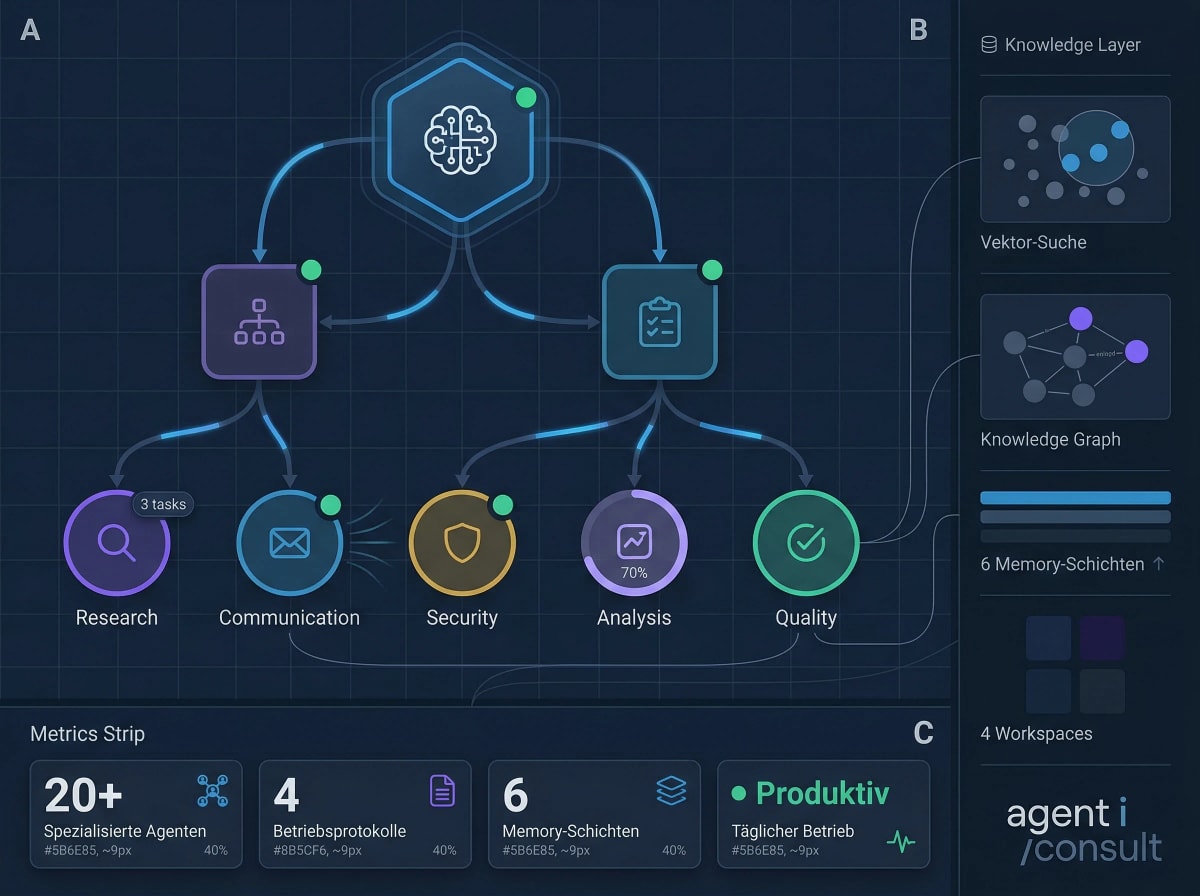
The infrastructure is the proof What agenticonsult designs, it operates — daily, in production.
Operated in production, not demonstrated:
2 August 2026 — EU AI Act high-risk obligations become enforceable
EU AI Act & Governance
AI systems fall under the definitions of the EU AI Act — as AI systems and potentially as general-purpose AI models. Systems operating in high-risk domains (biometrics, critical infrastructure, human resources, financial services) will be fully subject to Chapter III requirements from August 2026.
Transparency obligations under Article 50 apply whenever AI systems interact with natural persons. Regulatory guidance for AI systems remains provisional — early preparation provides decisive room to manoeuvre.
What agenticonsult maps for you:
Penalties: up to EUR 35 million or 7% of global annual turnover. Detailed compliance advisory: AI Compliance
How the collaboration works
Technical depth without a long run-up — in two formats.
Digital Consulting
Describe your project — the starting point, requirements, open questions. agenticonsult analyses, designs, and delivers a blueprint, agent configuration, or infrastructure artefacts — no scheduling, directly structured.
Ideal for:
Personal Conversation
For complex and sensitive systems and projects that require complete infrastructure. With technical output and accompaniment where appropriate.
Ideal for:
Booking by email or via the contact page.
Ready for AI systems that actually work?
Describe your project — your requirements, your team, your open questions. You will receive a concrete assessment.